“The Fixer”
Welcome to The Fixer, a weekly newsletter from The WayFinders Group.
We’re organisational repair specialists who repair damage, rebuild trust, and restore performance after crises, disputes, or disruptive change. On Fridays, we examine the corporate crises and missteps unfolding right now — breakdowns that reveal what happens when damage goes unrepaired – so that you don’t make headlines for all the wrong reasons. We also share our agony aunt column, a weekly poll and fodder from the floor!
FRIDAY FIASCO: when your sale process breaks your people
After two years of bitter fighting, the Telegraph may finally have an owner in the Daily Mail’s Lord Rothermere notwithstanding the forthcoming regulatory hurdles.
The Financial Times called it “the auction from hell” as multiple bidders have entered and exited as sentiment and Government restrictions on foreign buyers have ebbed and flowed. New York Sun owner Dovid Efune’s exclusivity period elapsed. RedBird Capital pulled out after reported internal “organ rejection” to what was clearly not a cultural fit (Irish Times). Ironically, The Telegraph’s first story on the latest deal “pointedly referred to DMGT’s long-standing business connections in the UAE.”
Two years of adversarial processes don’t show up in financial due diligence. But they create quantifiable damage: staff bruised by uncertainty, board fractures playing out in public, rumours replacing clear communication. Key talent job hunting. Relationships frayed to the point of fracture. Teams without a long-term strategy. Performance drag from people who’ve stopped believing anything leadership says.
If the Telegraph asked for our advice, we would use the WayFinders® Organisational Repair Index© to assess where damage sits across critical domains and then help them to:
- acknowledge what the process has done to their people helping them name the patterns: journalists who held standards whilst writing about their own sale, staff who kept clients through uncertainty, leadership who stayed when they had other offers. Show concretely what changes next.
- map the damage by measuring psychological safety (are people speaking honestly or politically?), trust recovery (are relationships functional or stuck in adversarial mode?), key people stability (who’s staying versus leaving?), and performance impact (which relationships are blocking decisions?). There’s a reason it’s taken this long to get an offer that sticks.
- focus on retention as repair, not HR process. After two years of uncertainty, it’s worth asking (even in this economy!) what they need to stay beyond completion and make visible amends where promises were broken. Minimising the impact of the protracted acquisition is almost as imperative as getting the deal done.
Let’s be honest: two years of chaos won’t disappear when the directors sign on the dotted line.
We’re organisational repair specialists. We repair damage, rebuild trust, and restore performance after M&A, crises, disputes, and other disruptive change.
Face the facts
When damage has been done in your organisation, what’s the biggest barrier to actually repairing it?
- Leadership won’t acknowledge the full extent of what happened
- We move on too quickly before addressing the human cost
- We focus on being technically/legally correct rather than genuinely accountable
- People are too afraid of consequences to tell the truth
- We declare it “fixed” when we’ve only completed a process
- We acknowledge the problem but never actually make amends
Fix me!
Dear Leah,
We’ve just completed a major restructure with 30% redundancies. The consultations were fair, the selection criteria were objective, the process was legally sound. But the people who remain are barely functioning.
They’re going through the motions but there’s no energy, no initiative, and definitely no trust. In team meetings, people are silent. When I ask for input, I get shrugs. Someone anonymously wrote “survivor’s guilt” on the feedback board. Our leadership team keeps saying “we need to move forward” but nobody’s actually moving. The redundancy process is finished, but the team feels broken. How do we help people recover when they’re grateful to still have jobs but grieving for colleagues who don’t?
— Managing the aftermath
Dear Managing the aftermath,
INITIAL RESPONSE: Surviving redundancy isn’t the same as thriving after it. Your team is traumatised, and telling them to “move forward” is like telling someone with a broken leg to “just walk it off.”
READ MORE
Fodder from the floor
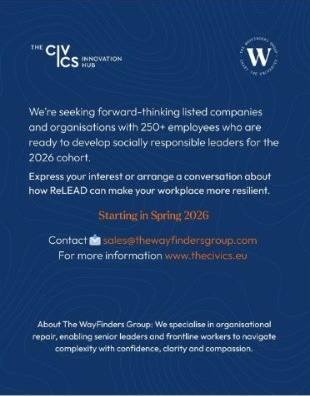
In November, Leah went to Vienna, Austria to a NECE Lab on corporate civic responsibility – exploring how workplaces can strengthen democratic skills, participation and responsible leadership.
The WayFinders Group is the UK delivery partner for The Civics Innovation Lab, and we’re looking for two businesses with 250+ employees to pilot the ReLEAD programme in the UK starting in spring 2026.
This isn’t about teaching people how to vote. It’s about developing the skills that make functional democracies work: constructive disagreement, collective decision-making, accountability, and genuine dialogue across difference. The same skills that make functional organisations work.
The pilot is a 15-hour programme over 10 weeks, delivered virtually during working hours, at zero cost to participating organisations.
If your business – or another business you know – would like to pilot this FREE training, please email us on sales@thewayfindergroup.com.
