The report was the easy part
The findings land, and the board accepts them. A response is published. An action plan goes to the people they answer to. On paper, the organisation has responded, and that is the easy part. A response on paper is not a change in the room; acting on a finding means changing what people do, and that is where it stalls. The recommendations that would change things need the people named in the report to work together, and those people are the least able to. So the safe recommendations get done, the hard ones do not, and at the next review the same finding lands again.
Repair is the work that turns an accepted report into real change: the recommendations delivered, the relationships that have to carry them repaired, and the evidence, measured before we start and again at the end, that it has been done.
Why repair is needed
When something goes wrong, organisations reach for the thing they can point to. After a cyber breach last year, 61 per cent of UK businesses took action to prevent a recurrence, most commonly a change to people or training. The harder work, changing how people behave once the report is filed, is the work that gets left.
Tribunals show the strain. There were 531,000 employment tribunal claims open at the end of March 2026, and the wait from claim to decision now runs to 59.6 weeks, well over a year. And a hearing settles the claim, not the team it came out of. Of the 68 UK public inquiries held since 1990, only six have ever been checked to see whether their recommendations were implemented; when the House of Lords reviewed its own 2014 report on inquiries, it found that of 33 recommendations, 19 had been accepted and, as far as it could tell, not one had been put into practice.
Sources: DSIT and Home Office, Cyber Security Breaches Survey 2025/2026; Ministry of Justice and HMCTS, tribunal statistics 2025/2026; Institute for Government; House of Lords.
Case study

Problem
Within a union, a relationship had broken down across two teams. Poor leadership had left fractured relationships, unclear responsibilities, and enough resentment to stall decisions and the work itself. Trust had gone, and managing through it had not worked.
Actions taken
We were asked to repair the damage. Working through the WayFinders Method, we ran confidential interviews across both teams to establish the full extent of it, then brought people together so leadership could acknowledge the specific failures and take responsibility for them. From there we rebuilt the practical things trust runs on: clear responsibilities, decision-making protocols, and regular check-ins the leader could sustain. Team members helped redesign how the teams worked and were governed.
Outcomes
The work made plain that the leadership approach no longer fitted what the organisation needed, and that was resolved. Both teams returned to full function, decisions moved faster, and cohesion improved. The organisation got its attention back for the work that matters, and the capacity to catch a breakdown in trust early, before it compounds.
What repair is and what it is not
Repair is not a return to how things were. The event happened, and pretending otherwise is what lets it happen twice.
Done properly, repair leaves an organisation in better condition than the event found it: relationships that can hold honest challenge, decisions people are willing to own, and trust rebuilt on firmer ground than before. It can’t be delegated entirely to a policy, a training module or an AI system; it needs someone who can sit in the discomfort with the people involved, hear what happened, and create the conditions for what needs to happen next.
It is restorative in method and legally informed. It is delivered with the people involved, one to one and in groups, rather than imposed on you from outside. And it runs in a bounded block of booked days, worked through your existing meetings rather than bolted on top of them.
Our instrument: the Organisational Repair Index®
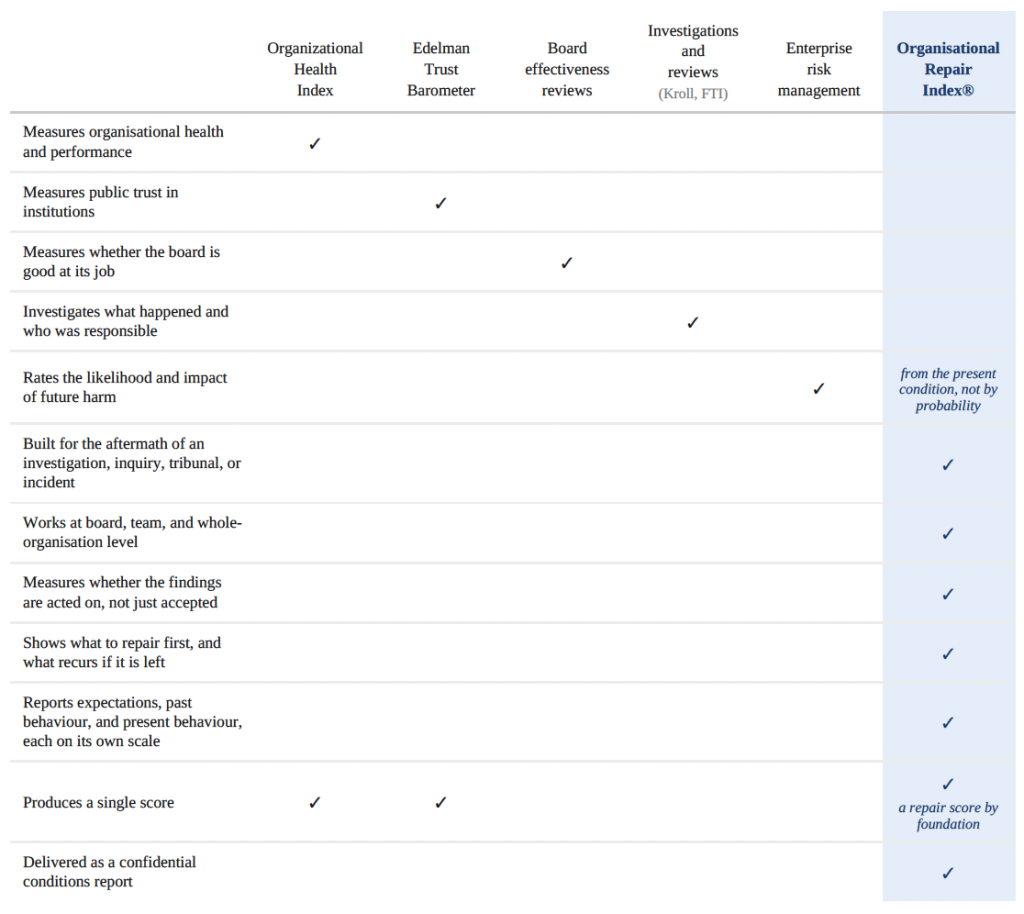
Everything we do is anchored to one instrument. Our Organisational Repair Index® measures expectations against behaviour, past and present, across four domains.
- Decisions. How decisions get made once the process is over, who is really making them now, and whether anyone will own them.
- Information. What people will still say after watching what happened to those who spoke, and what is now being held back.
- Relationships. Whether the people the report named, and the people who gave evidence, can still work together.
- Governance. Whether the structures that were in place throughout can be relied on to carry the recommendations.
We do not measure trust directly. Trust is what people feel when expectations and behaviours line up, and the mistrust an event leaves behind is the distance between the two. The instrument reads where what people expect and what they experience have come apart so that we are able to use the data to rebuild trust.
The instrument is applied at three levels.
Board ORI™️ | Team ORI™️ | Main ORI™️ |
A psychometric assessment completed by every board member. Within two weeks, the chair has data in a form you can put in front of a regulator or an oversight body as evidence rather than assertion. | It applies in situations where the damage sits below the boardroom: the team a tribunal came out of, the group a senior departure left behind, the function that has quietly stopped telling its leaders the truth. | The instrument read across a whole organisation rather than a single board or team, for the moments when the question is not what one group is carrying but what the culture is. Due Q4 2026. |
How the work runs
Advise. Confidential counsel to the chair or chief executive on what has been damaged and what repair would involve.
Measure. The relevant ORI, completed by the people involved, returning a conditions report across the four domains.
Repair. Restorative, legally informed work with the people involved, across a booked block of days, run through your existing meetings. We future-proof the original recommendations, so what the review asked for is still standing once we are no longer in the room. Then we measure against the same baseline again, and you have evidence of what changed.
What you get
The service is sold as one bundle.
- Implementation advice and direction-setting. We turn findings and recommendations into a practical order of work.
- Data-driven mapping of your current position, across decisions, information, relationships, and governance.
- A conditions report: a baseline of expectations, behaviours, and workplace conditions.
- Structured internal recovery, delivered through the WayFinders Method, a restorative process facilitated with the people involved rather than imposed on them.
- Future-proofing, so the original recommendations become part of how the workplace operates.
How our instrument compares
Partners